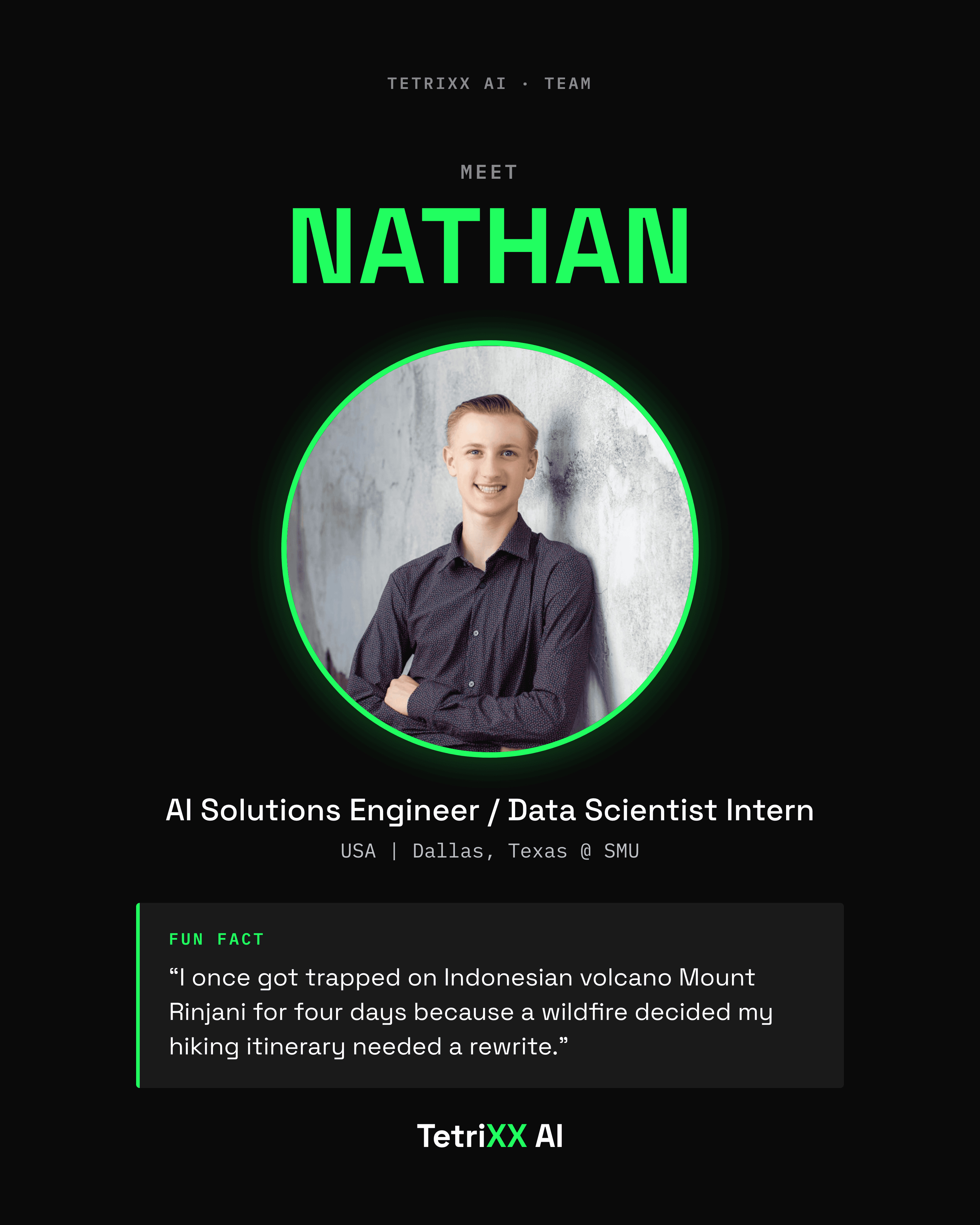
Creative thinking in AI-assisted data science, by where the human contribution sits. Includes the sirius freight cost index, why cost pressure has to be inferred from scattered signals, methods borrowed from surveying, property appraisal and economics, where AI defaults to the conventional answer, and testing that fell from weeks to an afternoon, explained by the intern on the project.
There is a version of data science that gets taught in classrooms and repeated in job descriptions in which the work is essentially obedient. You are handed a clear question, you select the right method from a known list, and you turn the crank.
My internship at TetriXX AI taught me that the most interesting problems rarely arrive in that shape.
Table of Contents
- What is sirius, and why can't freight cost pressure be measured directly?
- What is the creative act in a data science project?
- What do surveying, property appraisal and economics have to do with freight?
- What is AI good at, and where does it default to the conventional answer?
- What changes when AI makes testing an idea cheap?
- Does AI make creative thinking obsolete?
What is sirius, and why can't freight cost pressure be measured directly?
The project I spent most of my time on was sirius, an effort to build a cost index for freight. The premise was slippery because I was trying to measure something that cannot be observed directly. There is no single instrument that measures supply chain cost pressure. There are only scattered signals, including fuel prices, labor costs, congestion, capacity, rates, and other market indicators. The underlying condition has to be inferred from them.
That framing turned out to be the whole game, and it was where my contribution lived.
What is the creative act in a data science project?
My role was not to invent new mathematics. It was to draw on what I had spent years building in college, a working knowledge of how different fields have learned to estimate quantities that cannot be observed directly.
Across surveying, real estate, and economics, I had studied statistical methods designed for exactly that kind of problem. More importantly, I understood them well enough to see beyond their original contexts and recognize the structures underneath them.
The creative act was realizing that a problem in freight, which on the surface had little to do with any of those fields, shared the same underlying shape as problems I had encountered elsewhere.
That habit is harder than it sounds because nothing about a freight problem announces which intellectual drawer to open. Left to convention, you reach for the obvious supply chain tools and stop there. I found it more useful to strip the problem down to its abstract form and ask where else I had seen that form before.
What do surveying, property appraisal and economics have to do with freight?
A surveyor cross-checks imperfect readings against one another.
A property appraiser adjusts for the characteristics that make two assets difficult to compare.
An economist estimates hidden forces from the observable traces they leave behind.
Each discipline developed its methods for a completely different purpose, yet each method resembled, at a structural level, the problem I was trying to solve. The work was recognizing that resemblance and proposing it. It meant putting an unfamiliar concept on the table and saying, "This might belong here."
What is AI good at, and where does it default to the conventional answer?
This is where AI changed the nature of the job.
AI is genuinely good at taking a framework you provide and running with it. It can adapt a borrowed method to a specific dataset, implement it, test it, and expose its weaknesses with remarkable speed.
But AI also tends toward the conventional answer. Ask it how to approach a freight problem, and it usually proposes what one is expected to propose. It does not reliably make the leap from freight to surveying, property appraisal, or another seemingly unrelated field because that leap exists in the gap between subjects that are rarely discussed together.
The most interesting move was often, almost by definition, the one the system would not have proposed on its own.
What changes when AI makes testing an idea cheap?
What AI changed was the economics of testing those moves.
My part was identifying which concepts might apply and explaining why. AI's part was collapsing the cost of proving them out.
Under the older way of working, taking a method from an unfamiliar field and adapting it to a new problem could require weeks of implementation before you knew whether the approach was sound. That cost acted as a filter, and not always a useful one. Well-founded ideas from adjacent fields could remain untested simply because confirming them was expensive.
With AI, a carefully chosen approach could be translated into our specific setting and evaluated in an afternoon.
That shift matters more than it first appears.
When testing an idea is expensive, ideas matter less because you can only afford to pursue a small number of them. When testing becomes cheap, the quality of the ideas becomes the central constraint.
The bottleneck moves away from execution and toward two things machines still cannot fully provide. The first is generating unlikely but defensible connections. The second is judging honestly whether the resulting output is real or merely plausible-looking.
The fast, confident answer is not always the correct one. Part of my job was knowing enough to push back. I had to notice when a tidy result did not actually fit the situation and send it back for reconsideration.
Does AI make creative thinking obsolete?
That, in the end, is what the internship reinforced for me about creativity in a technical field.
Creativity is not conjuring something from nothing, and it is not made obsolete by automation. If anything, AI makes it more valuable.
As the cost of execution falls, the scarce resources become increasingly human. These include a broad and deeply studied foundation that makes unlikely connections visible, the discipline to determine whether a method from one field truly belongs in another, and the judgment to distinguish a sound result from a convincing imitation of one.
The value was never only in the machinery. It was in the years of study that allowed me to look at a surveyor, an appraiser, and an economist while facing a freight problem and see, with reason rather than luck, that their instruments might be the right ones.
AI then provided a partner fast enough to help prove it that same afternoon.