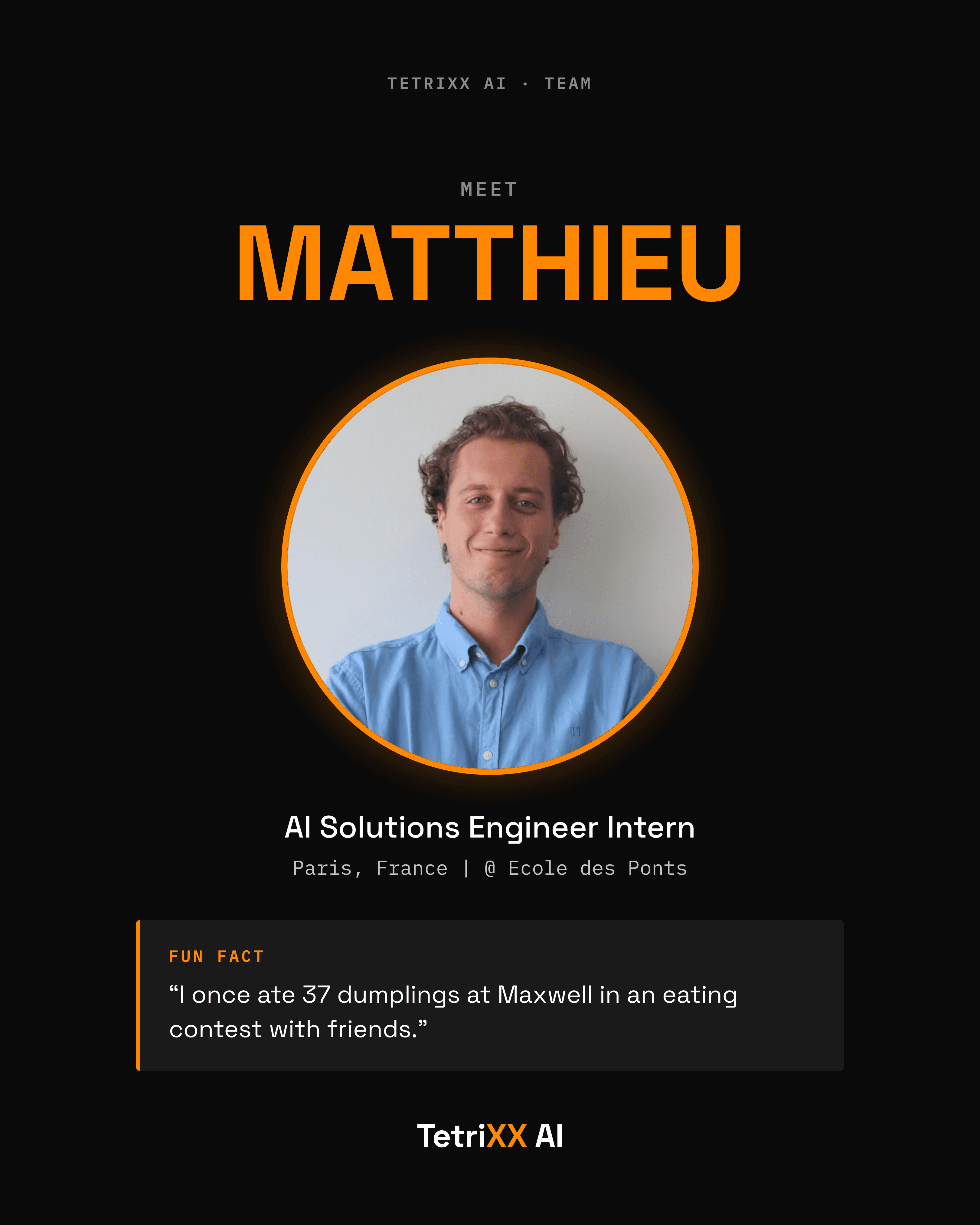
Real cost drivers of AI agents in logistics, by design decision. Includes the token ceiling that stalls an agent mid-task, model choice as a freight mode, agent architecture, data formats and tool calls as hidden cost, the machine-or-human mix, and the case for no AI at all, explained by Matthieu Mayaud, who built AI agents at TetriXX AI.
When I worked at TetriXX AI building AI agents for the logistics world, I was obsessed with the same question as everyone else: how smart can I make this thing? It took one frustrating afternoon to realize I had been asking the wrong question.
Table of Contents
- Why does an AI agent stop mid-task?
- What makes an AI agent expensive to run?
- Which tasks should go to AI and which to a human?
- When is no AI at all the right answer?
Why does an AI agent stop mid-task?
That afternoon, an agent I had built simply stopped mid task. It had run out of room. Large language models can only hold so much information at once, and mine had filled that space to the brim. The work was not finished, and the right question finally arrived. It was not how smart the system could be. It was how carefully it spent the little capacity it had.
Here is the thing nobody tells you when you start working with these models. Everything they do consumes tokens, the basic units of text they read and produce, and that supply is not infinite. Hit the limit and the agent stalls. Stay far below it and you are leaving capability on the table. And every token consumed, multiplied across hundreds of runs a day, is exactly what drives the cost of the whole system. The first reflex of almost everyone, myself included, is to feed the model everything, just in case. It works beautifully right up until it does not, and it quietly inflates the bill the entire time.
And that is where my background started talking to my screen. Because this exact problem already has a name in the world I was building for. It is called logistics.
What makes an AI agent expensive to run?
In freight, you never move something the most expensive way just because you can. You do not put a pallet of non-urgent goods on a plane when a ship will do. You consolidate small shipments into one container instead of sending ten half-empty trucks. You watch the chokepoints, the ports and canals where everything backs up, because that is where cost and delay explode.
A token behaves exactly like a unit of freight. It has a cost to move, and there is only so much room to move it. Optimizing an AI system turns out to be the same discipline as optimizing a supply chain.
How do you choose which model runs which task?
Choosing which model handles a task is choosing a mode of transport. The powerful model is air freight: fast, capable, expensive, and worth it only for cargo that truly needs it. The lightweight model is sea freight: slower and cheaper, perfect for the routine high volume work. Bundling several small requests into one is consolidation. And that capacity ceiling I hit is the chokepoint. Fill it carelessly and everything slows down, stalls, and costs more.
What are the hidden token costs in agent design?
But the model is only the most visible cost. The rest hides in the design. How you architect your agents, whether one does everything or a team of specialists each handles a narrow slice, changes how much context every step has to carry. The file formats you choose to pass data between steps matter too: a bloated, verbose structure spends tokens on every handoff, while a lean one moves the same meaning for a fraction of the load. And every call out to an external API or tool pulls a response back into the model, where it is read, paid for, and counted against the ceiling. None of these feel like cost decisions when you make them. All of them show up on the bill. Designing an AI system means accounting for them deliberately, not discovering them afterward.
Once I saw it this way, the design decisions stopped feeling like engineering trivia and started feeling like operations. I was no longer tuning a model. I was running a route plan.
Which tasks should go to AI and which to a human?
There is a second layer to this, and I think it is the one that will quietly become a real boardroom topic over the next few years, especially in supply chain.
It is not only a choice between a cheap model and an expensive one. It is a choice between a machine and a human action. An AI can often do a task in seconds, but with a tail of cases where it is wrong, and where being wrong is costly. A human does the same task more slowly and at a higher hourly cost, but with judgment, accountability, and a signature when one is legally required.
So the real question is rarely "should we use AI here." It is "what is the right mix." Let the machine handle the high volume, high confidence work, and reserve the slower, more expensive human attention for the ambiguous cases where it actually changes the outcome. That ratio is not fixed. As models get cheaper and roomier, the machine's share grows. As regulatory risk rises or the work gets more exotic, the human's share comes back. The mix becomes a dial you adjust continuously, not a switch you flip once.
When is no AI at all the right answer?
Which leads to the lesson I did not expect. The mark of maturity is not putting AI into everything. It is knowing where to take it out. Some tasks are better, cheaper, and more reliable handled by a deterministic script or a simple human check that consumes no tokens at all. AI used everywhere is theater. AI used where it earns its keep is leverage.
This is exactly the discipline TetriXX AI practices every day: deciding where intelligence is worth its cost, which work belongs to a model and which belongs to a person, and how to route each task so nothing is moved the expensive way without reason. The future of intelligent supply chains will not be won by whoever runs the biggest model. It will be won by whoever is best at routing: the right mode, on the right route, for the right cargo. Optimizing freight and optimizing AI obey the same law. I just happened to learn both at the same time, in the same place.